
The CSS or Central Superior Services exam in Pakistan is one of the most respected and competitive Pakistan exams supervised by the FPSC. Every year, thousands of aspirants, especially recent graduates, begin their preparation phase with enthusiasm but often face confusion during the selection process.
The CSS syllabus 2025 and CSS syllabus 2026 are designed to evaluate an aspirant’s understanding, knowledge, and analytical ability through a detailed set of subjects. These subjects are divided into two main categories — compulsory subjects and optional subjects — each carrying specific marks and weightage. To make things clearer, the FPSC syllabus outlines the entire syllabus division, ensuring that candidates know what to study and how to plan their CSS preparation effectively.
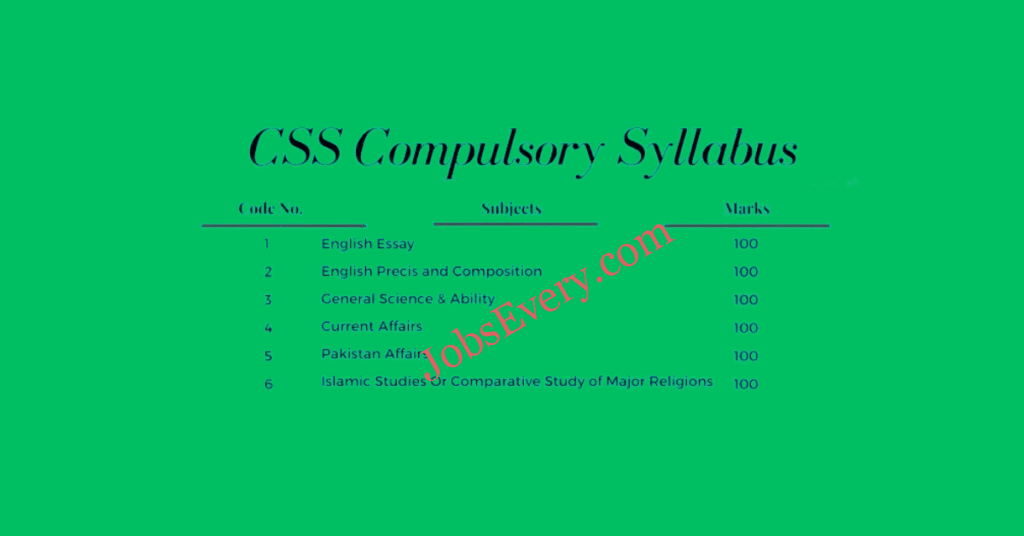
Compulsory Subjects of CSS Syllabus 2025:
CSS Optional Subjects
When I first began understanding the CSS syllabus in Pakistan, the part that intrigued me the most was the section about optional subjects. These subjects play a crucial role because a large portion of the total marks—specifically 600 marks, which are the half-passing marks—depend on them. Every candidate must make a carefully considered selection of these optional subjects.
A wrong selection can easily lead to failure in the exam, something I learned the hard way while helping friends who were also selecting CSS optional subjects. Before deciding, successful candidates usually gather information and seek tips on how to choose wisely from the list of optional CSS subjects given in the syllabus.
The CSS optional subjects are divided into seven groups, each comprising multiple disciplines.
Group 1
In Group 1, candidates must select one subject of 200 marks only. The code list includes accountancy, auditing, economics, computer science, political science, and international relations. I found international relations particularly interesting because it connects theory to global events, which later helped me in understanding policy analysis.
Group 2
Moving to Group 2, candidates may select one subject of 200 marks or two subjects of 100 marks each. Here, the subjects like physics, chemistry, applied mathematics, pure mathematics, statistics, and geology appear. Many science graduates I’ve known find this group easier since it allows them to leverage their academic background, especially those with a solid command of numbers and formulas.
In Group 3, Group 4, Group 5, Group 6, and Group 7, each allows you to select one subject of 100 marks only, but they cover different knowledge areas.
Group 3
Group 3 focuses on management and governance-related fields like business administration, public administration, governance, public policies, town planning, and urban management.
Group 4
Group 4 takes you deep into history with history of Pakistan, India, Islamic history, culture, British history, European history, and history of USA.
Group 5
Group 5 emphasizes natural and literary sciences such as gender studies, environmental sciences, agriculture, forestry, botany, zoology, English literature, and Urdu literature.
Group 6
Then comes Group 6, where candidates can explore law, constitutional law, international law, Muslim law, jurisprudence, mercantile law, criminology, and philosophy.
Group 7
Lastly, Group 7 brings together social and regional studies, offering journalism, mass communication, psychology, geography, sociology, anthropology, Punjabi, Sindhi, Pashto, Balochi, Persian, and Arabic.
From my own CSS study experience, I learned that the syllabus book and CSS coaching resources play a key role in shaping focused learning. Understanding subject relevance, your academic background, and prior education can make your subject selection more strategic.
The FPSC Pakistan recommends a strong link between chosen subjects and your interest, so each aspirant can align the topics with their education requirement and personal strengths. The CSS written test includes a total of 1200 marks — 600 marks for compulsory and 600 marks for optional papers — which shows a balanced marks distribution across all CSS groups. This structure helps maintain fairness while testing depth of understanding.
The syllabus details, including syllabus pattern, syllabus organization, and syllabus classification, are well-defined to simplify the exam preparation process. Every guide, CSS book, and learning material emphasizes the importance of following the CSS structure and CSS paper pattern to build a strong foundation.
Candidates are encouraged to go through CSS subject selection strategies and attend coaching classes for expert aspirant guidance. With the right CSS schedule, steady study, and awareness of the education system, aspirants can overcome candidates confusion and perform better in the CSS exam. The CSS system ensures that each syllabus content area contributes to developing a capable officer who understands both national and administrative challenges.
In addition to the main structure, the CSS syllabus details also include vital metadata such as the total marks, optional category, and compulsory category division. These categories help both the aspirant and the FPSC maintain transparency in the CSS system and keep the syllabus organization clear for every participant.
Understanding optional selection becomes crucial at this stage, as it allows candidates to balance their exam preparation efficiently by choosing subjects that match their academic background and interest. From my perspective, focusing on this metadata helps in creating a clear plan that aligns study goals with the official syllabus classification requirements.